HIPAA Compliance Checklist for Virtual Operations in Physical Therapy Practices (2026)
- Janhavi Parmar
- Jun 20
- 2 min read

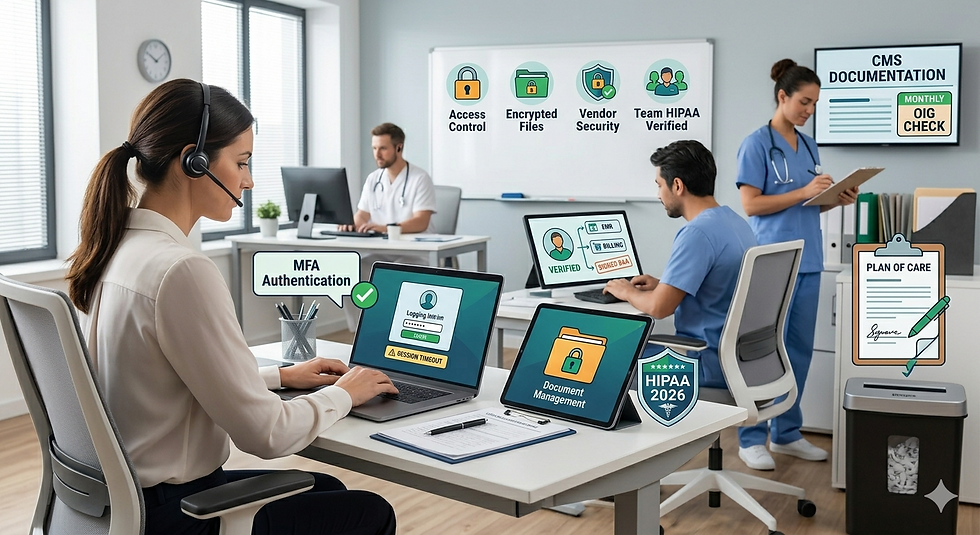
The shift toward virtual administrative operations has changed how physical therapy practices need to think about HIPAA compliance. It's no longer just about what happens inside your four walls. Every remote touchpoint — EMR access, document sharing, scheduling communications — is a potential compliance exposure point.
The good news: virtual operations, done correctly, can actually improve your compliance posture by centralizing oversight and reducing the informal information-sharing that happens in busy front offices.
EMR and system access
All virtual staff must access EMR systems through role-based permissions — no shared logins
Require multi-factor authentication (MFA) for all remote EMR access
Enable session timeout after 15 minutes of inactivity
Audit access logs monthly — know who accessed what, and when
Offboard access immediately upon end of contract or employment
Document management and file handling
All PHI (Protected Health Information) must be transmitted over encrypted channels only
Do not use personal email (Gmail, Yahoo) for any patient-related documents
Use HIPAA-compliant cloud storage with audit trails — not standard Google Drive or Dropbox
Establish a document retention policy aligned with your state's requirements (typically 7–10 years for PT records)
Shred or securely delete PHI that exceeds its retention period
Business Associate Agreements (BAAs)
Every vendor or contractor who touches PHI must have a signed BAA on file before accessing any patient data
This includes your virtual operations team, EMR vendors, billing services, and scheduling software
Review BAAs annually — vendor relationships and data practices change
Staff training and protocols
All virtual staff must complete HIPAA training before beginning work — document completion dates
Train specifically on phishing and social engineering — virtual workers are higher-risk targets
Create an incident response protocol: who to notify, in what order, within what timeframe (breach notification is required within 60 days)
CMS and NCQA requirements for 2026
Beyond HIPAA, physical and occupational therapy practices billing Medicare must maintain compliance with CMS documentation requirements. For 2026, CMS continues to require:
Signed plan of care for every episode of care
Progress notes that justify medical necessity at each stage
Functional reporting aligned with G-codes where applicable
NCQA credentialing standards also require ongoing monitoring of provider sanctions through the OIG exclusion list — practices must check this monthly, not just at onboarding.
The virtual compliance advantage
Counterintuitively, practices using professional virtual operations often have better HIPAA posture than those relying on in-house staff. Why? Because virtual operations teams have standardized compliance workflows, documented procedures, and centralized oversight — versus the informal, ad-hoc practices that develop in busy offices where people take shortcuts under time pressure.


Comments